A traffic engineer and a routing developer
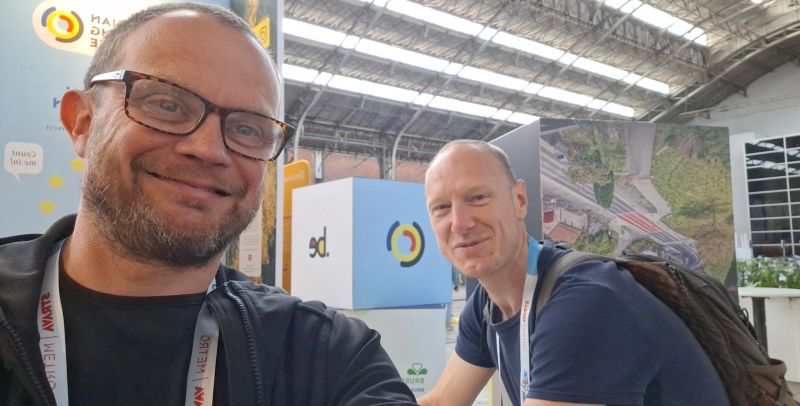
ANYWAYS is Wim and Ben, a traffic engineer and a software developer.
We met in 2014, when Wim was looking for something quicker than a full traffic model on every project. He found Ben — almost by accident — who had spent years building an open-source route planner. The original idea and the combination of both backgrounds made ANYWAYS grow into a solution for traffic engineers and consultancies.
Many real-world projects, user feedback and a lot of fine-tuning later, ANYWAYS has become a strong alternative to the traditional traffic models.
Two worlds meet
Traffic engineering on one side, routing and open data on the other. What Wim wanted to build never got started where he worked, and the idea waited.
ANYWAYS founded
Founded on one baseline: edit, test, publish. Not a traffic model but a route planner whose map you can edit.
Gent circulatieplan
A city centre reorganised in one go. Our route planner explained the new circulation to residents.
Consultancies pick it up
Studiebureaus start using ANYWAYS for their own projects, Suunta first, on MinderHinder. The roadmap has come from them since.
A proven method
Thousands of projects and scenarios, in real studies for real clients — circulation plans, road works, school streets, traffic impact assessments.
Neither of us could have built this alone
Most mobility software comes from one world or the other. Tools built by modellers ask you to think like a modeller. Tools built by developers don't know what has to survive a council meeting.
Wim comes from transport planning and engineering. He studied it at Salford, then spent years on station accessibility studies — the kind of work that ends up being defended in front of a client, a council, or a room full of residents.
Ben comes from OpenStreetMap, GIS and routing. He wrote Itinero, the open-source routing engine ANYWAYS runs on, and has spent years on the question of what a road network actually is as data.
ANYWAYS is what those two look like sitting in the same room, every day, for ten years.


Between a spreadsheet and a traffic model
Traditional traffic modelling was built to answer an economics question: how do we move the most cars through a network, as efficiently as possible?
Today the question is different and more complete: what kind of environment do we want to live in? This includes concerns like climate, safe streets, air quality, public space that belongs to people. How do we give more space to slow travellers?
You can't answer those questions with a model that treats streets as pipes and cars as flow. And you shouldn't need a €50,000 study and six months of calibration to find out what happens if you close one street.
So we built something different, not a traffic model, but something close to it, better suited to today's use cases.
1,472
Scenarios built
Comparing options is the whole point. Most projects need more than one.
483
Projects created
Real cases for circulation plans, road works schemes and school streets.
21,146
Road network changes
Every edit made to a road network to find out what would happen.

What we believe
A few things we keep coming back to, in the tools we build and the way we work.
- Mobility is about places, not vehicles
- Every street is also someone's front door, someone's school route, someone's terrace. The quality of the place matters as much as the traffic moving through it.
- The tool should match the question
- "Should we close this street?" shouldn't require six months of calibration and a five-figure budget. Small questions deserve fast answers.
- Cities should have agency
- Test your own ideas, compare your own scenarios, present your own evidence — without depending on an external model for every question.
- No black boxes
- Our approach is based on routing, not simulation. When a resident asks why traffic would move to their street, you can show them exactly why.
- The real issues
- We didn't build this to make traffic flow faster. We built it so the real issues behind a project — climate, sustainability, safety — can be prioritised and defended with evidence.
- Open by default
- A lot of what we build is open source, though not all of it. Open is more than a licence — it's how we organise ourselves and how we work with clients and partners.
Part of a bigger community
ANYWAYS runs on open data and open source. We are members of the organisations that make that possible, and we sponsor the events that bring the community together.



Talk to us
Ask a question, describe a case you are working on, or tell us what is missing.